Category Archives: Event

Introducing the DWeb Camp 2026 Venue: Alte Hölle

As our group of DWeb Camp organizers arrived at Wiesenburg station, frazzled by countless train delays in Berlin, a light rain and a blossoming gray winter sky welcomed us.

Moments after our arrival, a car and a van swooped up in front of us. Two of Alte Hölle’s stewards, Marv and Störte, had come to pick us up. During our days at this former forest hotel, we heard a common refrain: Imagine this place greener and warmer. Still, we did not have to stretch our imaginations very far. From the very first moment we laid eyes on Alte Hölle e.V., the only thing we could see was DWeb Camp 2026.

“We are just starting to wake up,” Marv told us while we looked across the property in late February. Just a couple of weeks earlier, snow levels reached an almost record 71 cm, and temperatures sank to double digits below zero. We arrived at this Brandenburg event space as bare trees, families of wild boars, and humans alike were emerging from their winter hibernation.
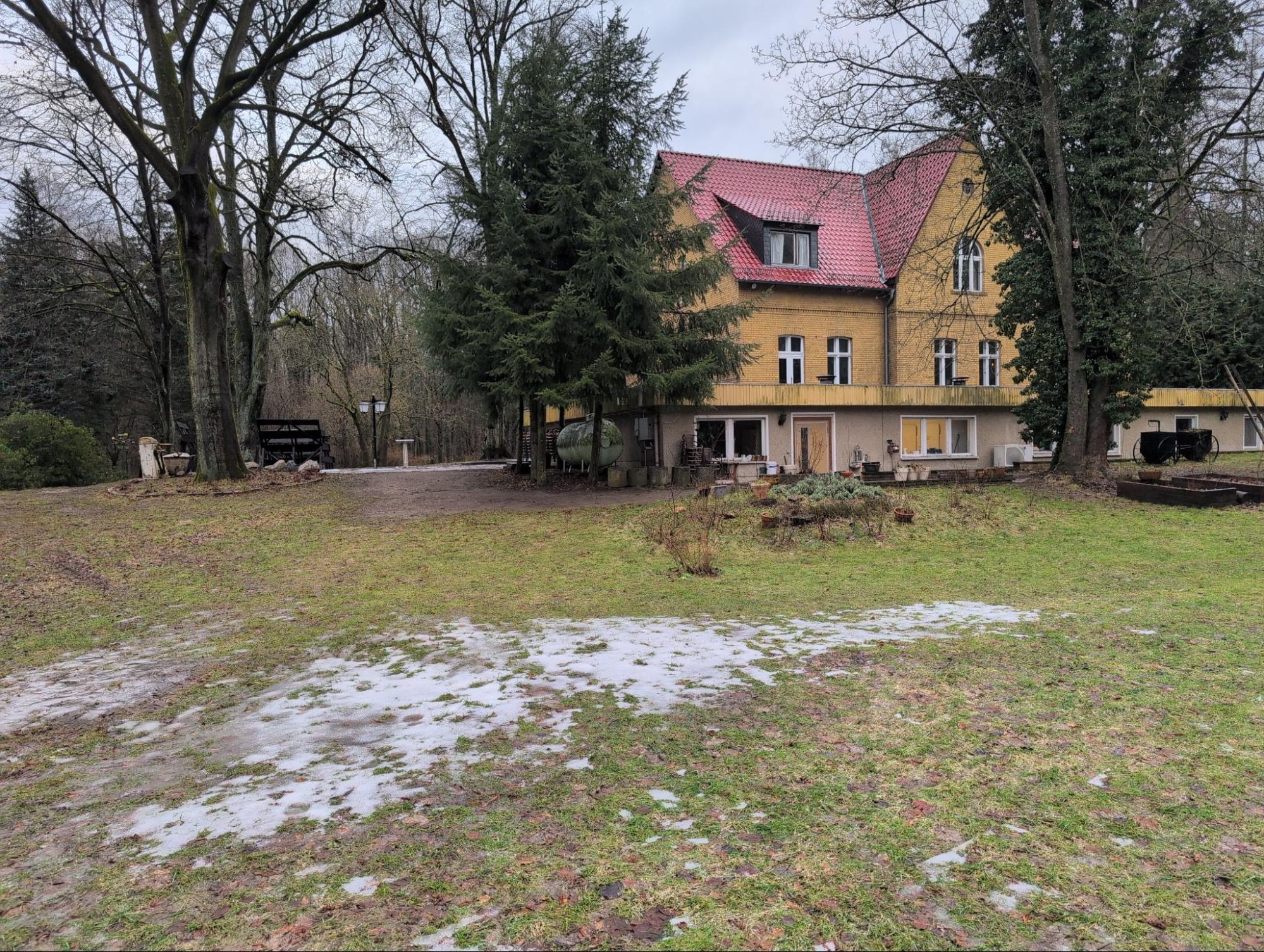
A photo of the main building of Alte Hölle during our Winter visit

Alte Hölle has a very special history. Originally built in the 1800s as a Prussian forestry administration center, it later became a recreational facility for the Secret Service of communist Eastern Germany. Then a woman purchased it in the 1990s and managed it for three decades as a forest getaway spot. By 2021, the hotel wasn’t making a profit and she was searching for successors to take over. The full potential of this historic venue was yet to be recognized and realized.
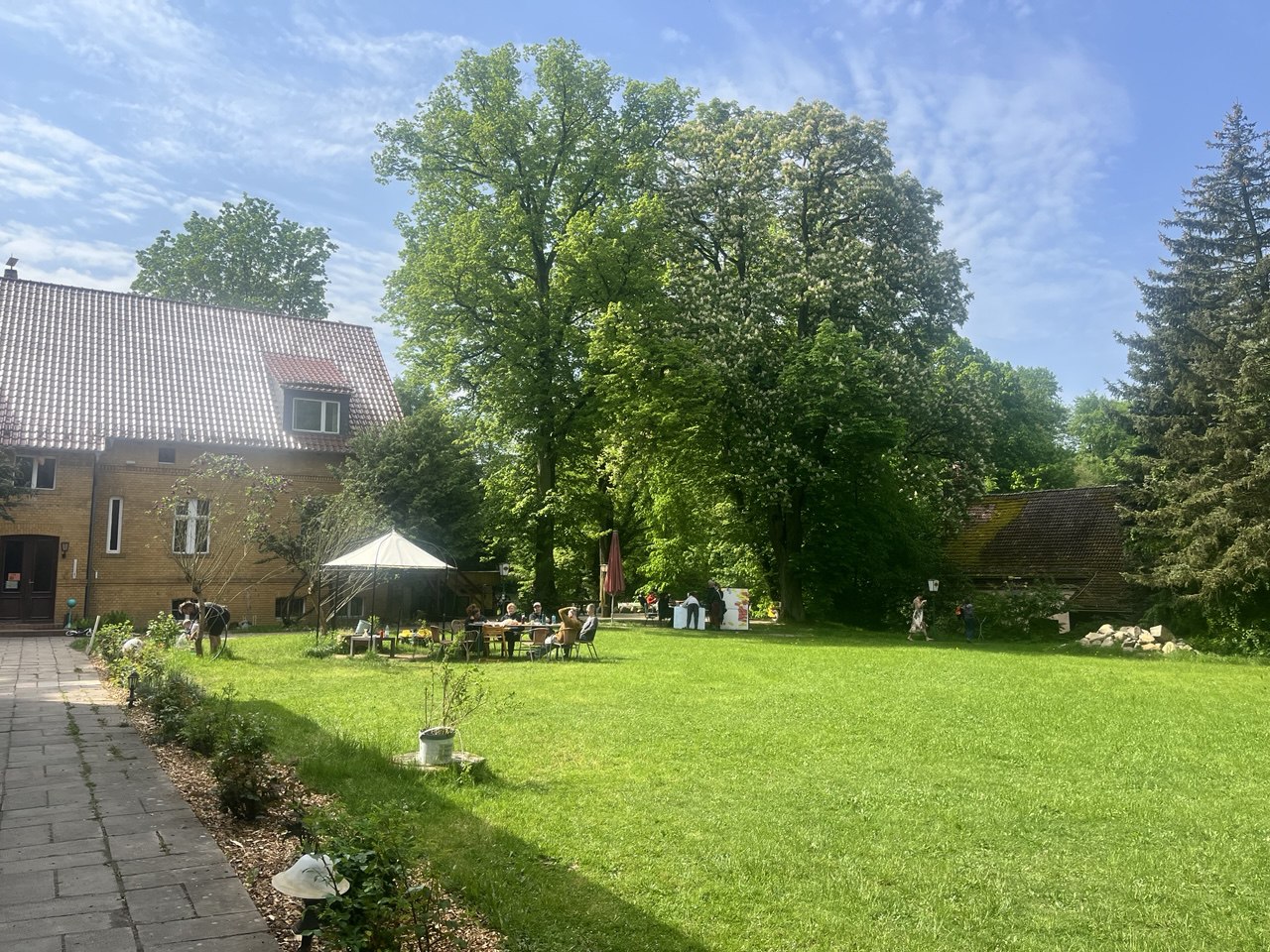
A photo of Alte Hölle during the summer
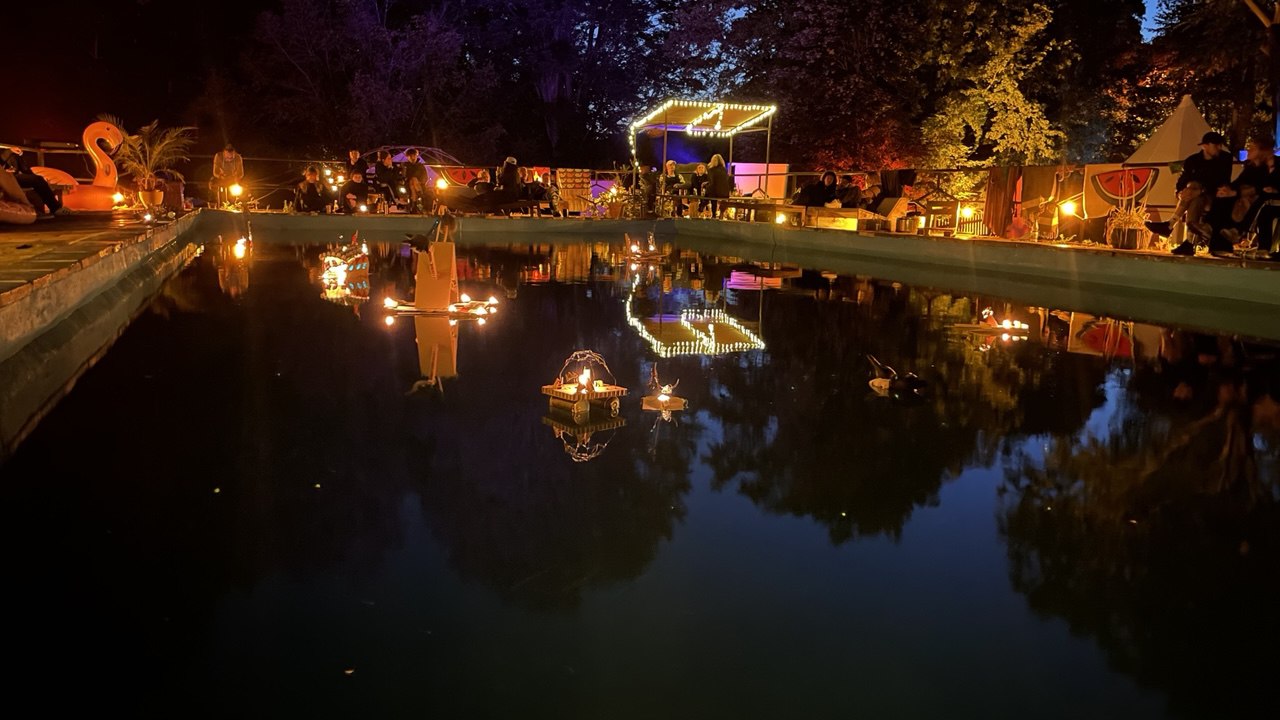
The pool of Alte Hölle at night

At the same time, a diverse ensemble of friends who met at Chaos Communication Congress got together, looking for a place to establish a physical base to gather, build and host events and festivals. The old forest hotel was finally seen by the right sets of eyes, imagining it in a new light!
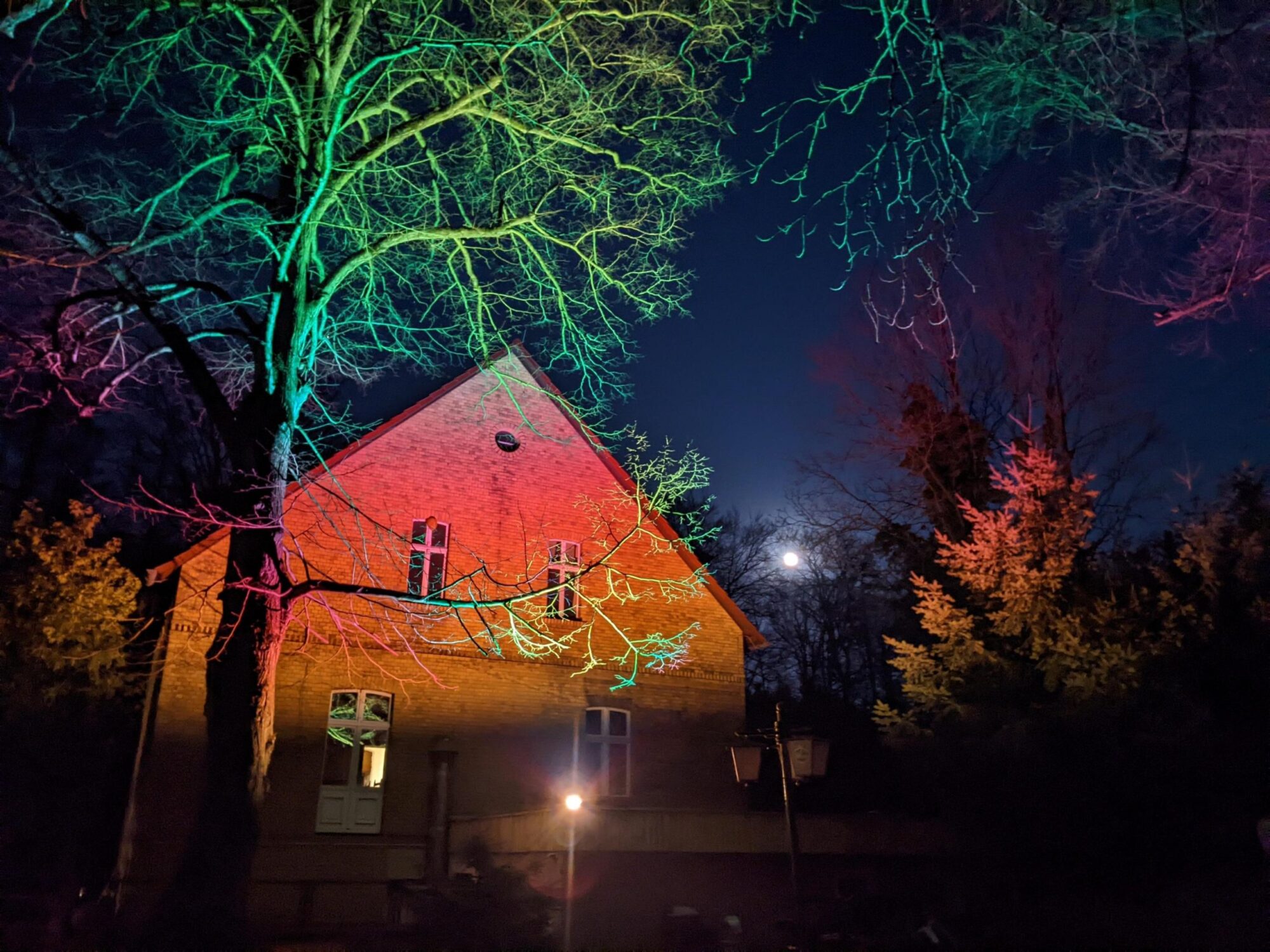
The façade of the hotel at night, lit by coloured lights

These ardent builders and dreamers booked the whole hotel for a week, coming up with ideas and ways to infuse the space with new life. After witnessing their process, the original owner slowly decided that selling her life’s work to a loose group of DIY enthusiasts was really the best option.

In 2021, this group purchased Alte Hölle, transferring the property to an association to ensure its long-term stability as individual involvement shifts and changes. Ownership by an association establishes Alte Hölle as a collectively-run physical commons. The members of the collective chipped in smaller amounts to secure a long term loan, thus collectivizing and decentralizing ownership and financial risk.

Rural Brandenburg isn’t exactly a cultural hotspot attracting scores of young people. Yet, for the Alte Hölle collective this place offers an opportunity to usher in change and a new cultural presence in the Brandenburg area. We don’t want to be a group of happy dropouts isolated from society, Störte explained to us. Our intention is to look outward, participating in local initiatives, bringing people to this place, and being a backbone for community organising and democratic practice.

The Alte Hölle collective welcomes open involvement in decision-making and shaping the future of the project. Alte Hölle’s governance model is non-hierarchical and based on consensus. It’s hard to distinguish between who lives there and who doesn’t: people come and go, but they still actively contribute to decision-making and developing Alte Hölle’s infrastructure. We want to blur the lines as much as possible between who is here and who is not, because not everyone can afford to work remotely and stay long term, but this should not influence their sense of belonging to the project, says Franzi, one of the stewards of the venue.

Alte Hölle runs as a seminar hotel for a broad variety of groups. Other collectives come there to organize retreats, literary groups hold reading events on the grounds, bike enthusiasts come for week-long workshops. And from July 8-12 2026, Alte Hölle is welcoming DWeb Camp.

How did we select this unique place an hour southwest of Berlin? It becomes clear if you look back at the history of Camp and the principles that guide our decisions.

Since our first outdoor convening, we’ve aspired to work closely with our venue’s stewards to help improve the land. We did so at the Mushroom Farm in 2019, when we brought stable internet to the remote California coastal location by building a tower and installing antennas across the property to establish a local mesh network. We want DWeb Camp to be firmly grounded in a place. A place with history, community, strong values, and aspirations. A place that shares our principles of giving agency to people, distributing value and power broadly. DWeb seeks to achieve this in the digital realm; Alte Hölle does so in a collectively-run 100,000 square meters of forest and field.

In November, we sent an email to share our ideas and explore the possibility of hosting Camp at Alte Hölle. Marv was the first to see our inquiry. As I read that email, a few things immediately just clicked. The right values, talks and workshops with interesting content and initiatives. I sent a very enthusiastic reply, and a couple of weeks later we were walking the place together with a first exploratory delegation from DWeb.

Then in February, a dozen members of our team convened to survey the site and start planning the details.
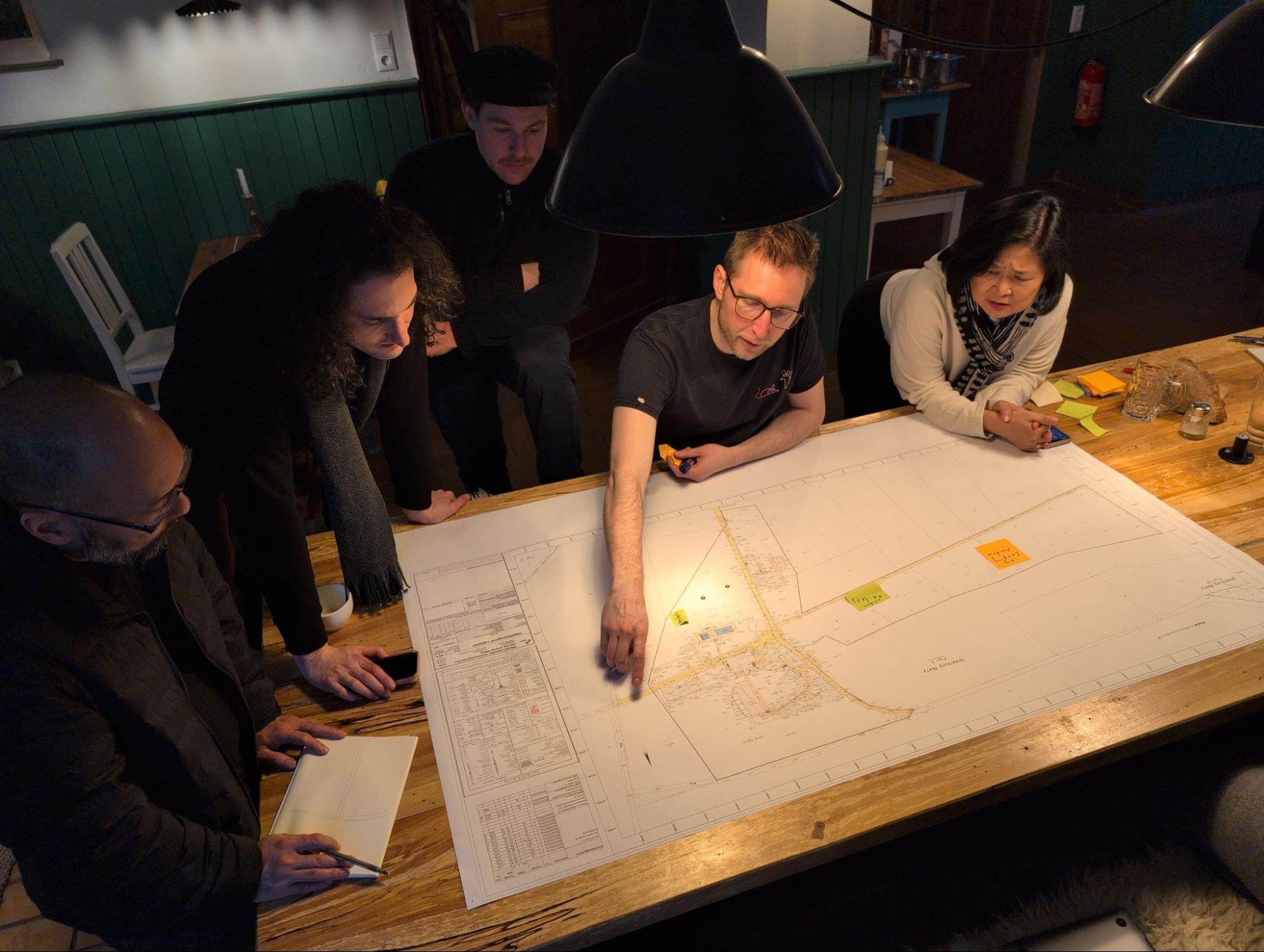
Marv of Alte Holle pointing out power, connectivity, and other features of the 100,000 square meters of the property.

So now, the organizing machine is in full motion. We are meeting the vibrant culture of Alte Hölle with the joyful spirit of DWeb Camp. Not only will we have a lot of infrastructure to build, but also many things to make! Using wood sourced from local forests, we plan to craft benches, tables, and some other key structures we’ll need at camp.

The DWeb and Department of Decentralization organizers and the Alte Hölle community are looking forward to welcoming you to this land of rich history and abundant promise.

As Franzi shared, I love the idea and the principles behind DWeb Camp, and I am really looking forward to having an international event with many people coming from all around the world!
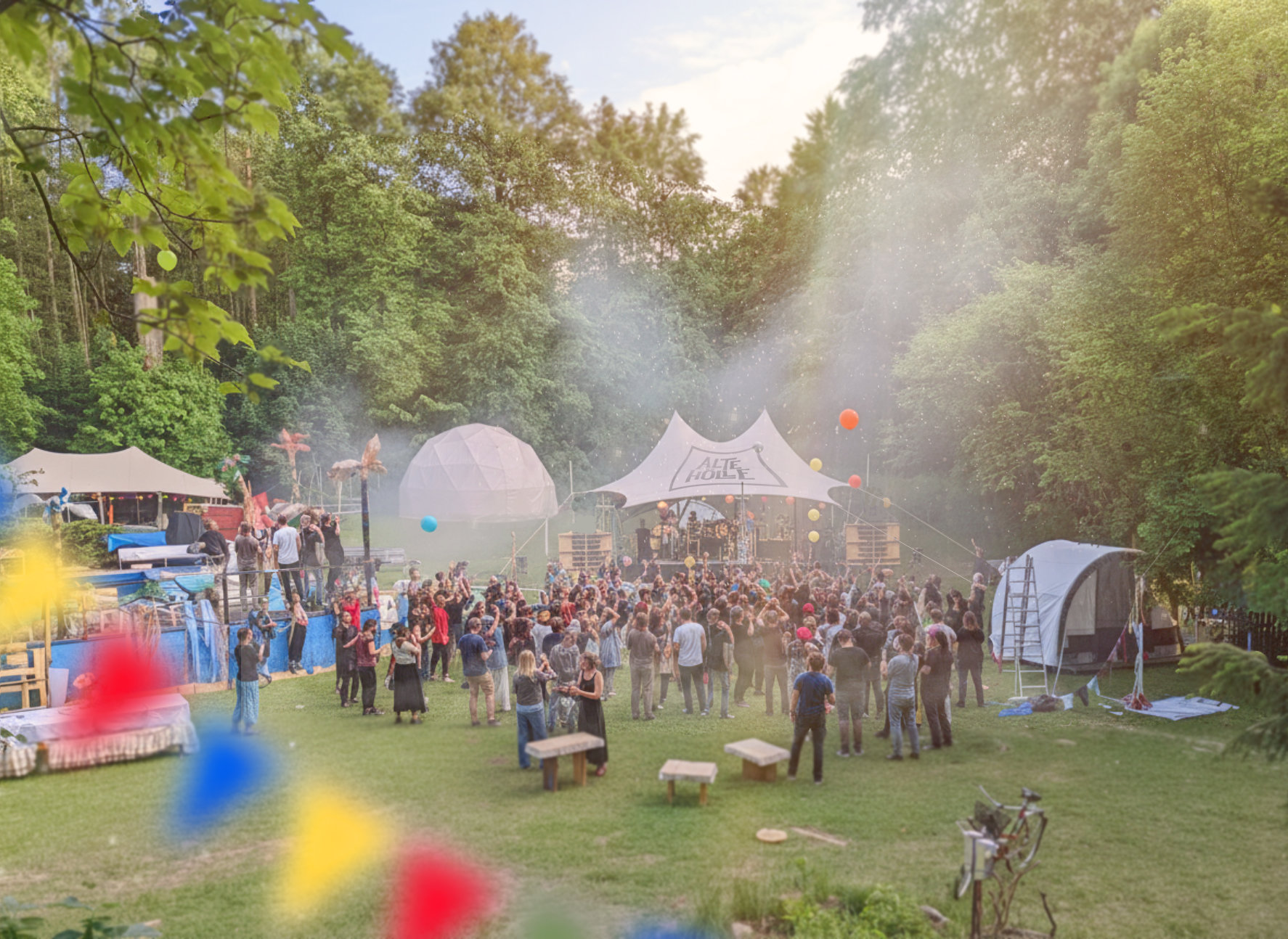
A music festival at Alte Hölle
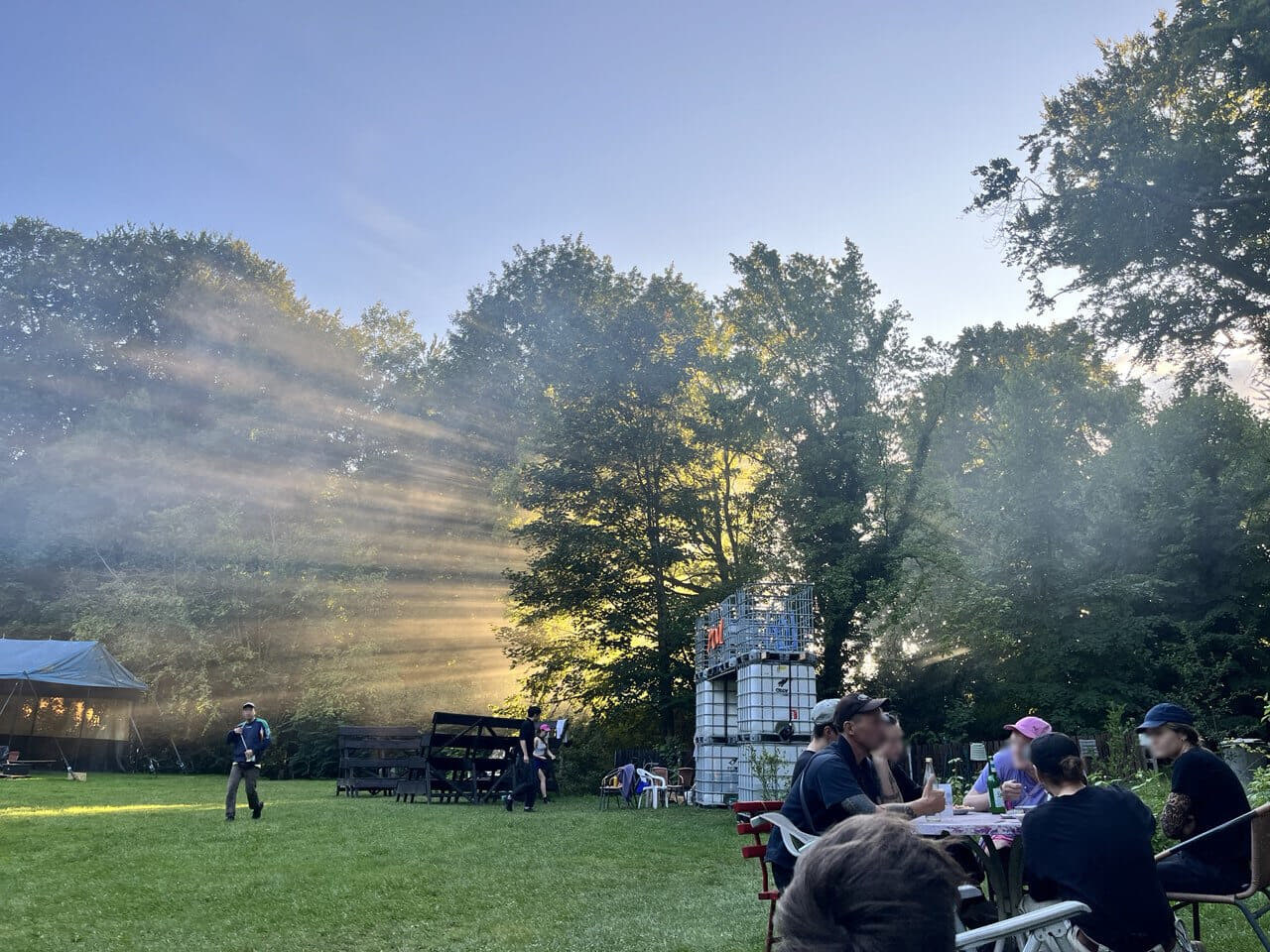
Sunrays and people walking on the Alte Hölle field.

How DWeb Camp is Being Built in Berlin

At the legendary c-base, technologists, activists, and artists gathered to shape the next chapter of the decentralized web.

c-base is a space station that “crashed” and is being reconstructed along the Spree river by a group of Berlin hackers. Some call it the mother of all hackerspaces.

On a gray February morning in Berlin, people wandered down a dark ramp into a space station.

Not a metaphorical one—at least not entirely. c-base, with its blinking lights, maze of cables, and decades of hacker lore, has long described itself as a space station that crashed on Earth 4.5 billion years ago. Since the mid-1990s it has been a gathering place for coders and tinkerers who prefer to build the future themselves rather than wait for it to arrive.

On this particular morning, they had come to design something new.

In February, an invitation had circulated across Europe’s decentralized technology networks: come to c-base and help shape the next DWeb Camp, a five-day gathering that will take place this July in the forests of Brandenburg.

There was no fixed agenda, and no finished plan.

Just a question.

If we were to build the next version of DWeb Camp together, what might it look like?

Before long, the room filled. Peer-to-peer developers had come from Edinburgh, free-software advocates from Berlin, privacy-first technologists from Shanghai, and policy thinkers from Copenhagen. Artists, funders, open-source builders, and organizers filtered in carrying laptops and winter coats. Most of them had never met before.

They had come not just to attend—but to help build something.

The timing was not accidental. Across the world, the systems shaping the internet—and increasingly public life—are consolidating. Governments tighten control. Platforms encroach on our privacy. The internet as we know it is splintering, and along with it, our consensus about what is true. For many in the room that morning, the pressing question was can we restructure the web before it hardens into something more destructive than its early architects ever imagined?

DWeb Camp, first held in Northern California in 2019, grew out of that concern. The gathering was conceived as a place where technologists, artists, organizers, and policymakers might come together to begin building a more decentralized web.

A web built less like a pyramid and more like a forest. Distributed. Resilient. Sharing resources underground.

This summer, DWeb Camp’s theme is “Root Systems,” and it moves to Europe for the first time. The meeting at c-base was an early step in imagining what might grow there.

For an hour, Internet Archive founder Brewster Kahle answered the questions of DWeb Sr. Organizer, Wendy Hanamura, in a wide-ranging chat about public AI, his successes and failures, and the imperative for decentralization in this political moment.

Origins of a Decentralized Gathering

“It feels like I’m coming home,” Brewster Kahle, founder of the Internet Archive, said when he opened the morning.

Kahle traces some of the inspiration for DWeb Camp to the Chaos Communication Camp, the sprawling hacker gathering he first attended in 2003. But his vision was always more focused: an event where technologists could work alongside artists, organizers, and policymakers to imagine and build the infrastructure of a decentralized web.

“A web that’s more private, more reliable, but still fun,” he said, hopping up and down. “A web with many winners.”

Collective Intelligence

“It feels like I’m coming home,” Brewster Kahle, founder of the Internet Archive, said when he opened the morning.

Kahle traces some of the inspiration for DWeb Camp to the Chaos Communication Camp, the sprawling hacker gathering he first attended in 2003. But his vision was always more focused: an event where technologists could work alongside artists, organizers, and policymakers to imagine and build the infrastructure of a decentralized web.

“A web that’s more private, more reliable, but still fun,” he said, hopping up and down. “A web with many winners.”

Collective Intelligence

At c-base, Kahle and a dozen core organizers didn’t arrive with a finished program. Instead they facilitated breakout conversations, solicited unconference topics, and most importantly, listened.

Throughout the day, small circles formed across the space station, and similar themes surfaced again and again.

Not everything, participants suggested, needs to scale to billions of users. Perhaps some of the most important decentralized tools will serve smaller networks—families, communities, groups of collaborators who know one another. An intimate web, as some people called it, rather than the global one.

Others spoke about shared infrastructure in a broader sense: not just software, but the resources communities could distribute. Buildings. Time. Convenings. Knowledge. The question, several people suggested, was not simply how to build better tools but how to sustain the ecosystems that allow those tools to exist.

Hölke Brammer, of the Hypercerts Foundation, offered a framework that drew nods around the table.

“It’s said, first you need the values,” he recited.
“Then governance.
Then the right incentives.
And finally the technology to build it.”

DWeb Camp tries to bring all of those layers together in the same place at the same time. Which means inviting not just engineers but researchers, economists and storytellers.

Marek Tuszynski, co-founder of Tactical Tech, offered a wry observation about how the technology world often divides itself.

“They say technology is inspired in San Francisco,” he recounted. “It’s built in China. And criticized in Europe.”

The challenge, he suggested, was to move beyond those boxes—to collaborate across them.

Later, when participants were asked what would make the camp most valuable, one answer surfaced repeatedly.

“To find the people I want to work with after Camp,” someone said, “and figure out how to keep working together on an on-going basis.”

Grounded in Place

Franzi and Marv, two of the stewards of the Alte Holle Collective, share the terrain of the 100,000 sq. meters retreat site.

DWeb Camp has always been shaped by the places where it occurs.

When organizers began looking for a European site, they eventually settled on Alte Hölle, a forested property in Brandenburg about an hour southwest of Berlin.

The decision had as much to do with the people stewarding the land as with the landscape itself.

In 2021, a collective of friends who met at Chaos Communications Camp purchased the property—once a Stasi recreation site—with the intention of turning it into a long-term gathering place for artists, hackers, and activists.

Their question was straightforward.

Why build a camp only to dismantle it a few days later?   Why not create infrastructure that could remain?

Two of the site’s stewards, Franzi and Marv, joined the gathering at c-base. Rather than simply presenting the site, they participated in the discussions, listening carefully to the people who will soon gather there.

“We share a lot of the same values,” they said. “We are a volunteer group that supports [you] and is an ally for [your] event.” 

The goal, for DWeb organizers, is not merely to occupy Alte Hölle but to contribute to it—to plant something, rather than simply passing through.

The field where some 700+ campers will pitch their tents in Brandenburg.

Partners with Principles

Afri of Department of Decentralization demonstrates the programmable badge his team is developing for DWeb Camp. Via radio waves, you will be able to talk person to person at Camp, without going to the cloud or WIFI.

Strong collaborators don’t just support your vision. They push you to live up to it.

Berlin’s Department of Decentralization (DoD)—a collective formed after organizing ETHBerlin in 2018—has encouraged DWeb Camp organizers to align our tools more closely with our principles. That means prioritizing open-source infrastructure wherever possible.

Tickets will be sold through PreTix.
The schedule will run on PreTalx.
Collaborative documents will live on CryptPad.
Camp communications will be via Matrix.

Tools designed with privacy and security in mind. Not just talking about decentralization, but practicing it.

Building Across Borders

Some of the organizers of DWeb Camp from Alte Hölle, Department of Decentralization and the Internet Archive came together at c-base in February to plan for July.

Based across North America and Europe, the organizers of DWeb Camp 2026 have lineages that span the globe—Nigeria, Russia, Germany, France, Italy, Ukraine, Canada, Japan, and the United States. We come from different political contexts. Different assumptions about technology. Different cultural norms. The challenge–and the promise–is to weave those perspectives into something coherent, yet distinct. 

Toward the end of the day at c-base, Kahle returned to a theme that was disarmingly simple.

Welcome.

“This is a really special community…they welcomed me twenty years ago,” he said. “You may not be aware of the effect you have by saying ‘welcome’ to somebody from a foreign place. I think it is a hallmark of a community that is living and thriving.”

That small gesture, he suggested, can shape the direction of entire communities. “I hope that DWeb Camp is to your liking, if it’s not, say so, and let’s basically make it better. Let’s build something together.” 

Because DWeb Camp has never been a finished product.

It is something closer to a living system. It’s shaped by the people who show up, the relationships they form, and the ideas that take hold.

And in the forests of Brandenburg this July, those connections—technical, social, and human—will begin to spread beneath the surface.

Like any root system, their real strength may lie in what we cannot see.

View the fireside chat with Brewster Kahle and Wendy Hanamura.

Join Internet Archive and Partners for the National Summit on Local News Preservation

Join Internet Archive, Investigative Reporters and Editors (IRE), and the Poynter Institute for the National Summit on Local News Preservation. This event will bring together the producers, preservers, and users of local news to develop collaborative, scalable solutions to address the urgent preservation challenges presented by the rapidly changing local news landscape. 

This free, in-person event will be held on June 17, 2026 in conjunction with the IRE 2026 Conference in National Harbor, Maryland just outside of Washington, DC. 

Through panels, presentations, and facilitated discussions, Summit attendees will:

  • Discover proven strategies and partnerships behind successful local news preservation initiatives
  • Shape recommendations for local news preservation to be distributed nationally to newsrooms and memory institutions
  • Network with leaders from news and cultural heritage organizations
  • Explore tools and programs that can support the preservation and access of local digital news assets

Learn more and register to attend

This event is part of Today’s News for Tomorrow, a program supported by Press Forward. Additional support for the Summit has been provided by the Society of American Archivists Foundation. 

Recordings From Our Public Domain Day Celebrations are Now Available

This week, Internet Archive celebrated Public Domain Day with a lively mix of ideas, art, and community. Session recordings are now available to revisit or discover the highlights.

In our daytime virtual session, we invited audiences to step into The Case of the Disappearing Copyright, a playful, thought-provoking celebration of the works newly freed into the public domain. Watch the recording.

Our in-person party turned Public Domain Day into a lively celebration of art, film, and the public domain. Artist in residence Cindy Rehm shared The Seers, her public-domain–inspired work, followed by a screening of the winning films and honorable mentions from the Public Domain Film Remix Contest. Watch the livestream.

Internet Luminaries Unite to Defend the Open Web: “Let’s Have a Game with Many Winners”

Luke Hogg moderates a panel with Brewster Kahle of the Internet Archive, Vint Cerf of Google, Cindy Cohn of the Electronic Frontier Foundation, and Jon Stokes of Ars Technica on Oct. 27, 2025. (Foundation for American Innovation, Washington D.C.)

At Wayback to the Future: Celebrating the Open Web in Washington D.C., some of the internet’s founding figures gathered to reflect on what went wrong—and what might still be saved.

Hosted by the Foundation for American Innovation in the historic Riggs Library at Georgetown University, the panel brought together Vint Cerf (Google), Cindy Cohn (EFF), Jon Stokes (Ars Technica), and the Internet Archive’s Brewster Kahle.

Listen to the discussion via the Future Knowledge podcast:

Watch the discussion:

The conversation, moderated by Luke Hogg, focused on what the group called the “three Cs” behind the web’s decline: centralization, copyright, and competition. While the early web promised connection and creativity, today’s internet, they warned, is increasingly fragmented, paywalled, and dominated by a few powerful platforms.

Speaking beneath shelves of century-old books, Brewster Kahle posed a simple but urgent question: “Do we have these books on the internet anywhere?” His answer—“The truth is paywalled, and the lies are free”—captured the tension at the heart of the conversation.

As libraries and users lose access to information locked behind corporate and legal barriers, Kahle called for a renewed commitment to an open, decentralized web: “Let’s have a game with many winners.”

The Internet Archive, now having preserved over one trillion webpages, continues to model that vision by building a more resilient, distributed digital library—one where knowledge remains accessible to all.

One Trillion Web Pages Archived: Internet Archive Celebrates a Civilization-Scale Milestone

Photo by Ruben Rodriguez, October 22, 2025.

One trillion! There was no mistaking the number that was center stage at the Internet Archive in San Francisco on October 22.

“We are celebrating a major goal of one trillion web pages…shared by people all over the world, wanting to make sure that what they know is passed on,” said Brewster Kahle, Internet Archive’s founder and digital librarian. “It’s a fantastic, phenomenal success story.”

Watch the livestream:

Since 1996, the Wayback Machine has been saving the digital history of the internet. In October, it surpassed the threshold of preserving one trillion web pages—a fact that was met with enthusiastic applause each time it was mentioned at the party held at the non-profit research library’s Funston Avenue headquarters in San Francisco.

People should not take for granted the important role that libraries, including the Internet Archive, have played in compiling accurate information and making it accessible to all, said California State Senator Scott Weiner, who presented a Certificate of Recognition from the State of California Senate to the Internet Archive. “We’re seeing now in this country people trying to rewrite history and come up with alternative facts,” he said at the event. “What the Internet Archive and the Wayback Machine does is to make clear that everything is there. I am so deeply grateful.” [watch remarks]

California State Senator Scott Weiner. Photos by Brad Shirakawa, October 22, 2025.

In a video message, Vint Cerf, creator of the Internet and vice president and chief internet evangelist at Google, said the one-trillion-page mark is an incredible milestone. “[The Internet Archive] has preserved an enormous amount of history over the course of their data collection, something which I feel is absolutely essential,” he said. “In the absence of what they have done, the 22nd century will have no clue what the 21st Century was all about.”

Looking Back, Looking Ahead

The program included a glimpse back at early days of the web and a hopeful vision for the future.

“There was this dream of an internet that was made for us, by us, to be able to make us better people,” Kahle said. “Yes, using technology. Yes, having games with lots of different players and winners—a fun and interesting world, and that is very much still within our grasp.”

Audrey Witters, creator and community builder

Audrey Witters, a veteran of the early web, brought the audience back to 1994—when all existing websites could still fit on a single “What’s New” page. Reflecting on her early days at NCSA and her creative experiments on GeoCities, Witters shared the story of how a small animated alien GIF she helped create became an unlikely icon of the early web. “It’s so important for us to remember that context, that spirit, that joy of creation—what happens when you give people the tools and invitation to publicly and exuberantly celebrate themselves,” she said. Thanking the Internet Archive for preserving that era’s spirit of discovery and collaboration, Witters urged the next generation of creators “to look for new opportunities to promote exploration, collaboration, and joyful expression. Here’s to the next trillion!”

Lily Jamali, BBC News

Lily Jamali, an investigative journalist with BBC News, said she appreciates the Archive’s public service mission and tools that are “absolutely fundamental” to hold the powerful to account. “They help us journalists fact check claims,” she said from the Great Room stage. “They help us see how companies and governments may have selectively edited online materials, or even deleted statements or social media posted that they would rather that the public didn’t see.” [watch remarks]

Journalists can no longer rely on their news outlets to store their work, Jamali said, so many turn to the Wayback Machine to access past articles and inform their reporting.

In a highly entertaining segment full of Wikipedia screen shots and laughs, Annie Rauwerda, creator of Depths of Wikipedia, spoke about the crucial partnership between Wikipedia and the Wayback Machine. She highlighted how archived pages make citations stronger and more durable by ensuring that even when the original source disappears, the evidence remains. “If Wikipedia is worth anything at all, it’s because of the citations,” Rauwerda said.

Annie Rauwerda, Depths of Wikipedia

CEO of National Public Radio Katherine Maher offered her congratulations via video for the event. “One trillion web pages. That’s one trillion artifacts and snapshots of our interconnected world,” she said. “It’s a testament to the Internet Archives’ unwavering commitment to safeguarding the integrity of the open web and its history, ensuring that this vast digital record remains free and open for everyone.”

NPR and the Internet Archive share a deep commitment to providing access to information, a dedication to public service and a belief in strengthening societies through information and dialog, Maher said. “We live today in an era in which information is unstable. It emerges suddenly, decays rapidly, disappears instantly,” she said. “In this moment, the Archive’s role in preserving news, public discourse and our shared stories is more critical than ever.”

With Wayback Machine, ‘Knowledge Will Not Be Lost’

Mark Graham, director of the Wayback Machine

When the U.S. government websites started going offline after the change in presidential administrations earlier this year, Mark Graham, director of the Wayback Machine, said he wasn’t panicking. Why? Because since 2004 the Internet Archive has collaborated with many partners to save federal web pages, through the End of Term Web Archive effort. Since last fall, Graham described efforts to preserve more than 400 million web pages, 2 million videos and hundreds of thousands of data sets—all published by the U.S. government, and therefore available to the public. [watch remarks]

With the Wikimedia Foundation, the Archive has identified and fixed more than 28 million broken links from Wikipedia. It also added more than 4.2 million links to books and papers available from www.archive.org. Graham announced the new partnership with Automattic Inc. to make it easy for WordPress operators to automatically find and repair broken links with the Internet Archive Wayback Machine Link Fixer.

The Internet Archive faces challenges with the advent of AI. More services are blocking access, Graham said, making it harder for memory institutions, like the Internet Archive, to do their  jobs—yet, the team remains diligent in its efforts.

“We’re going to keep on building the library that the world deserves, one that remembers, one that connects us, and one that ensures no matter how much the web changes, that knowledge will not be lost,” Graham said.

The Path Forward

Luca Messarra, cultural historian, Stanford University

Luca Messarra, a humanities scholar and educator at Stanford University, said preserving webpages is important because the past is always shaping the present moment. “History is essential because it helps us understand how our own lives came to be. But more importantly, for me, history helps us understand how our lives can be made different,” he said. “The past tells us that the present does not need to be the way that it is.” [watch remarks]

Messarra said he has used resources from the Internet Archive to write conference papers, recover his old chat messaging history and recover a favorite family biscuit recipe.

“The Wayback Machine has tended to one trillion seeds that will nourish our future. All that remains is for us to harvest and use them,” Messarra said. “One trillion pages are one trillion opportunities to change our present moment. That requires that we look at the past not with nostalgia, but with initiative.”

The largest repository of internet history ever assembled is possible thanks to thousands of donations to the Internet Archive and 200,000 unique donors, said Joy Chesbrough, director of philanthropy. At the event, she announced a new campaign that encourages individuals to create their own fundraising teams to support the Internet Archive. See https://donate.archive.org/1t [watch remarks]

It was the largest gathering for the Archive’s annual party in years, said Chris Freeland, director of library services, and he hoped the gathering fostered a sense of connection.

“It was a nostalgic throwback, but it also showed people a path forward for a web that we want,” Freeland said. “I hope people come away with this sense of optimism and a thought that this is our web, and we can be in control of it again.”

Celebrate 1 Trillion Web Pages with Original Net.Art Works: Internet Archive x Gray Area

Pretty Guardian Shrine (2025) by Ophira Horwitz

Internet Archive x Gray Area: Trillionth Webpage Net.Art Commissions
Date: Saturday, November 1
Time: 5:00 to 8:00pm
Location: Internet Archive, 300 Funston Avenue, San Francisco
Admission: Free
REGISTER NOW!

The Internet Archive has reached an extraordinary milestone: one trillion web pages archived. This civilization-scale achievement marks decades of dedication to preserving the ephemeral nature of digital culture and ensuring universal access to human knowledge.

To commemorate this historic moment, San Francisco interdisciplinary arts and technology non-profit Gray Area has partnered with the Internet Archive to commission a series of original net.art works that engage with the vast holdings of the Internet Archive and explore what it means to create, preserve, and access culture online.

REGISTER NOW

Commissioned Artists

  • Chia Amisola
  • Spencer Chang
  • Sarah Friend & Arkadiy Kukarkin
  • Ophira Horwitz
  • Mai Ishikawa-Sutton & Raúl Feliz
  • Olivia McKayla Ross
  • Jesse Walton
  • Rodell Warner

The commissioned artists have drawn from the Internet Archive’s expansive collections to create web-based artworks that reflect on themes of memory, digital archaeology, and the human stories embedded within preserved data. These works exist as both online experiences and physical installations at the Internet Archive, bridging the digital and material worlds in ways that honor the Archive’s dual nature as both a technological achievement and a profoundly human endeavor.

Curated by Amir Esfahani (Internet Archive) and Wade Wallerstein (Gray Area)

Sir Tim Berners-Lee to Receive the 2025 Internet Archive Hero Award

Sir Tim Berners-Lee

Celebrating 1 trillion web pages archived, the Internet Archive is proud to honor the visionary who made it all possible. As announced in The New Yorker, this year’s Internet Archive Hero Award will be presented to Sir Tim Berners-Lee, inventor of the World Wide Web, whose groundbreaking work opened the door to a connected world and laid the foundation for our shared digital history.

The Internet Archive Hero Award is an annual award that recognizes those who have exhibited leadership in making information available for digital learners all over the world. Previous recipients have included the island nation of Aruba, public information advocate Carl Malamud, copyright expert Michelle Wu, and the Grateful Dead.

Sir Tim’s invention transformed how humanity shares knowledge, and his ongoing advocacy for an open and accessible web that empowers individuals continues to inspire us. We’re thrilled to recognize his enduring contributions as we mark this historic achievement for the web.

Sir Tim will receive the Hero Award at an event in San Francisco on October 9, and will be celebrated from afar during the Internet Archive’s annual celebration on October 22, “The Web We’ve Built.”

DWeb Camp Cascadia 2025: Canada’s First Regional Decentralized Web Camp in the Pacific Northwest

Banner for DWeb Camp Cascadia reads "Salt Spring Island August 8-10" over a blurry image of the venue, Farmers Institute

We’re thrilled to see how much our hope for DWeb to decentralize globally has been fulfilled this year. In our blog announcing the Core team’s decision to take a hiatus from holding DWeb Camp in California, our Senior Organizer Wendy Hanamura wrote:

[It] is time to put our energy into truly decentralizing DWeb. We want to nurture this movement in a way that empowers nodes around the world, especially those outside of the United States. We want to focus our energies in 2025 on helping local networks build capacity and grow. 

In 2025, we held gatherings in Taipei and Berlin before a summer jam-packed with DWeb happenings: DWeb was at What Hackers Yearn in the Netherlands, HOPE_16 in New York, along with the intensive, hands-on week of p2p and local-first protocol learning at the DWeb Seminar SF & Weekend (stay tuned for more writing to come from that).

And of course, DWeb Camp Cascadia, organized by the stellar folks of the DWeb YVR Node. By the spring, we had been hearing murmurs of their planning the event. It all came together when they decided to hold it early August on beautiful Salt Spring Island, a 45-minute drive and 90-minute ferry ride from Vancouver. This was only the second camp outside of California since DWeb+Coolab Camp Brazil in 2023. 

An image of a sunset from inside a tent, showing a blue cloudy sky over a field scattered with over a dozen other tents.
View from inside a tent at DWeb Camp Cascadia

For anyone who was there in 2019 at DWeb Camp at the Mushroom Farm — it felt so much like our first DWeb. It was held at the Farmers’ Institute, which is regularly used for an annual farmer’s fair for the whole island. About 60 participants in total attended throughout the weekend. An informal polling (raised hands during the opening) showed that about 40% of attendees traveled from the US, with the remaining 60% from Canada — several of whom live on Salt Spring Island itself. It spoke volumes that the local attendees really enjoyed the event while having various interests: from regenerative agriculture and responsible land stewardship to music and web development.

The event kicked off on Friday evening with remarks from Member of Parliament, Elizabeth May, whose federal electoral district spans across seven islands, including Salt Spring Island. As leader of Canada’s Green Party, May’s team is working to shape Canada’s upcoming AI legislation. She first gave an acknowledgement of the ancient indigenous history of where we were and its colonization. Then she called attention to Big Tech’s ongoing global dominance, and the recent occurrence of the democratically decided Digital Services Tax having been scrapped by the Canadian Prime Minister over tariff negotiations with the U.S. Following her speech, I (mai), gave a history of the DWeb events and shared the DWeb Principles, with campers getting up to read each of the five principles. Campers then got into small groups to discuss them, with a few of them coming up to share their own reflections.

An image of an audience of about 40 people sitting on benches outside, watching Member of Parliament Elizabeth May speaking on stage.
Campers watching Member of Parliament, Elizabeth May, speak at the Opening Session

Saturday and Sunday were packed with talks, discussions, and workshops. Unlike the main DWeb Camp where we have many concurrent tracks, mornings were a single track of programming followed by afternoons with three parallel unconference sessions. DWeb Camp Cascadia’s cornerstone themes were decentralization, democracy, open social networks, regenerative agriculture, and included community talks by local technologists living in and around Salt Spring Island.

Brooklyn Zelenka of Ink & Switch and spec editor for the UCAN distributed RPC and auth system, gave an excellent talk Saturday morning introducing local-first technologies and the affordances of networks that prioritize local, people-centric connectivity. Brooklyn described how big data “cloud” services centralize infrastructure in a way that always requires connectivity (such as when you can no longer edit a Google document when you lose internet access). Offering a powerful metaphor, Brooklyn suggested most services today rely on networks that act more like a military aircraft carrier, when many personal or local services could act more like a bike — nimble, resilient, and scaled down to meet the unique needs of individuals. You can check out the recording of the August DWeb Virtual meetup where she gave the same presentation. 

Image of Brooklyn Zelenka, standing on the opposite side of the room speaking to a large room of about 40 people sitting down.
Brooklyn Zelenka giving a talk on local-first networks

There was a cornerstone session for the Open Social Web, led by Nigini Oliviera (DWeb Seattle Node lead) and featured Ian Davis, Matthew Lorentz and Mike Waggooner, each discussing their work with ATProtocol, ActivityPub, and Nostr. They discussed the differences between social media protocols and how each of them hold potential for new apps to be built on them.

Jacob Sayles of Cascadia Collaborative Design gave a workshop on Meshtastic radios. All over the world there has been a growing popularity of LoRa (Long-Range) devices, particularly with the release of Meshtastic software that is increasingly making it easier for anyone to send short, SMS/text-length messages to those nearby. It’s completely decentralized in that it requires no dedicated router and enables messages to hop from device-to-device to go to its intended recipient(s). In practical terms, it’s currently most useful for emergency situations and other situations as an alternative to mobile and internet connectivity. While messages are encrypted, there are still privacy issues with the software/hardware that make it less useful for privacy-sensitive uses. 

An image of a butcher paper poster covered with marker writing and post-its for an unconference schedule.
Poster with unconference sessions scheduled on Sunday, the last day of Camp

Some of the unconference sessions included:

  • What would a decentralized iNaturalist look like?
  • Bioregional learning and digital tech
  • Robotics without data centers
  • AI safety and how to dwebbify AI
  • Conscious use of AI by appreciating artisanship
  • Clean tech + climate tech
  • “Privacy party” — sponsoring network effects
  • Fractal cells + self-organizing
  • How to contain sociopaths
  • Practical local-first
  • Pretzel and quark cheese making
  • Gymnastics + parkour

In addition to these sessions, what made the gathering feel like a DWeb Camp were the other activities throughout the weekend: yoga in the mornings, visits to local regenerative farms, and a hike through redwoods to swim in the ocean.

Two images: one on the left is of about 12 people walking down a path surrounded by tall redwoods, the one on the right of about 12 people on a dock near open water at sunset.
Photos of a hike through redwoods in Burgoyne Bay

On the first night there was an impromptu karaoke session backed by acoustic guitar played by Paul d’Aoust and cajon played by Nigini Oliviera. On Saturday night we had a dance party and on Sunday night — as may now be tradition — an open mic that featured nine campers showing off their music and comedy.

Image of a group of 7 seven standing on a stage around a table singing. The wall above them has a big banner of musical notes.
Campers singing karaoke along on the first night

What I often hear from campers year-to-year is that DWeb is exactly the kind of community they were looking for. People who are deeply engaged with what it means to design and build values-based technologies, who are also themselves people who clearly understand what it means to listen and take care of each other. Along with our curiosity and passion for how we can build better networks, campers are able to integrate that focus with how we are as people — how we want to be better in our communities and the lands we live on. At a time when mainstream technologies seem intent on stripping away our humanity with their use, cultivating these spaces not only feels critical, it’s exhilarating. 

On the ferry ride back from Salt Spring Island, members of the DWeb YVR Node were already starting to discuss plans to organize it again for next year with more campers. As someone who’s been involved in DWeb Camp from the beginning, I will say that seeing this event grow feels incredibly affirming: that there’s a need and desire to bring together in-person those ready and able to build  better digital networks during these turbulent times. 

Photo of a farm looking space with a field in the background, the sky is blue and orange with a sunset.
Sunset over the Farmers Institute, the venue for DWeb Camp Cascadia on Salt Spring Island, Canada

~

This blog post has been written by mai ishikawa sutton, Senior Organizer of DWeb and member of the DWeb Core Team. Learn more about DWeb at: https://getdweb.net/

Registration is Now Open for Internet Archive’s October Events

This October, the Internet Archive will celebrate an extraordinary milestone: 1 trillion web pages preserved and available for access via the Wayback Machine.

The series of events scheduled throughout October will highlight the people, technology, and community efforts that have made this achievement possible, and will look ahead to the future of web preservation as we continue building the web’s collective memory together.

Oct 7 – The Vast Blue We: An interactive evening of live music with Del Sol Quartet, featuring new works by Erika Oba and Sam Reider, exploring the wonder of human collaboration. (7–8:15pm PT | San Francisco & online)Learn more & register

Oct 21 – Doors Open 2025: Go behind the scenes at the Physical Archive to see the lifecycle of books, records, film, and more—from donation to digitization. (6–8pm PT | In person only)Learn more & register

Oct 22 – The Web We’ve Built: Our annual celebration, marking 1 trillion webpages preserved in the Wayback Machine. Join us in San Francisco or online for an evening of talks, performances, and community. (5–10pm PT | Live stream 7–8pm PT)Learn more & register