


I’ve been obsessed with the "Abstraction Tax" lately—the massive performance hit we take when we prioritize developer convenience over hardware reality.
To test this, I built the Axiom Hydra V3.0, a multi-threaded telemetry engine in pure C. I wanted to see how far I could push data ingestion on a consumer-grade Acer Nitro laptop.

The Benchmark (1.74 Billion Logs)
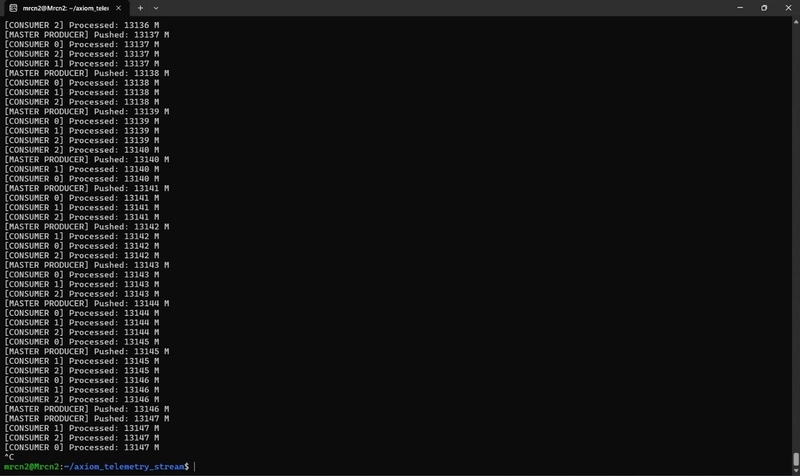
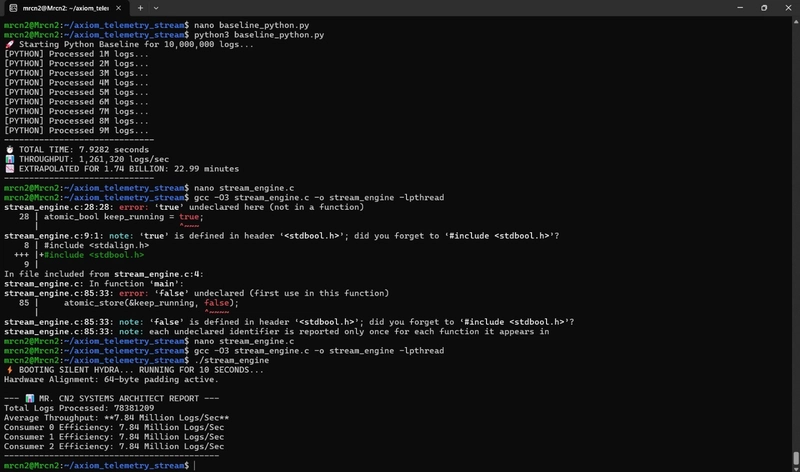
🐍 Python Baseline: 1.26 Million logs/sec (~23 mins compute)
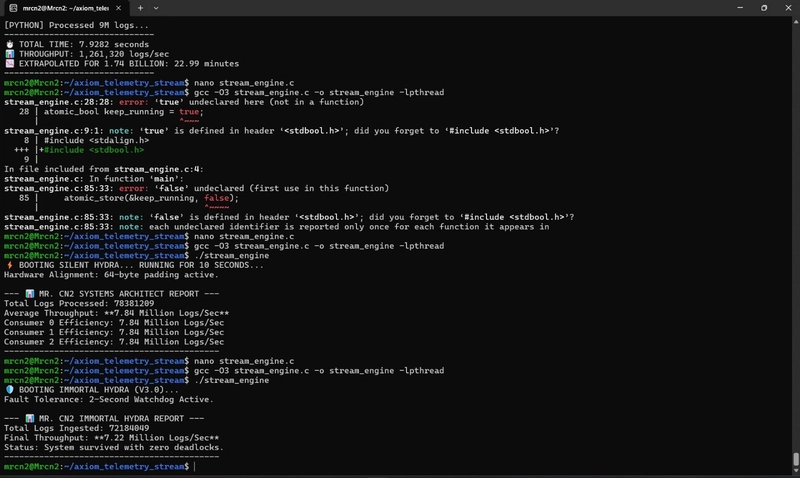
⚡ Axiom Hydra (C): 7.22 Million logs/sec (~2 mins compute)
That is a 91% reduction in compute time. ---
The "S-Rank" Architecture
How do you achieve 11x speedups without a cloud cluster? Mechanical Sympathy.
Cache Alignment (alignas(64))
Most multi-threaded systems suffer from False Sharing. When CPU cores fight over the same 64-byte cache line, the performance collapses. I used explicit hardware alignment for the ring buffer's head and tail pointers to ensure each core has its own dedicated lane.Lock-Free Synchronization
No mutexes. No semaphores. I utilized stdatomic.h with Acquire/Release memory semantics. This allows the Producer and Consumers to communicate at the hardware bus speed without context-switching to the Kernel.The Immortal Watchdog
Lock-free structures usually deadlock if a thread hangs. I implemented a heartbeat-based watchdog. If a consumer stalls, the Master Producer detects the "Ghost Head" and skips backpressure, keeping the global stream alive.

The Mission: Titan Aeon
This is Day 18 of my Solo Leveling journey—a 30-month protocol to build institutional-grade infrastructure from a bedroom. Engineering isn't about adding more servers; it’s about removing the friction between your logic and the silicon.
Check out the full source code on GitHub:
https://github.com/naresh-cn2/Axiom-Hydra-Stream


Top comments (0)