



You’ve been promised “Angular support” more times than you can count.
What you got instead was a React library in an Angular costume.
A thin compatibility layer. A demo that technically works, but feels wrong the second you try to build something serious with it.
Angular support is not the same as Angular respect.
And the more you look at how Angular tooling is actually built, the less patience you have for ecosystems that treat Angular like an afterthought.
The Lie Behind “Angular Support”
You’ve seen it.
A UI library announces Angular support.
You click the docs.
You get excited for about 15 seconds.
Then you realize what “support” really means:
- awkward APIs that feel imported from another ecosystem,
- missing Angular ergonomics,
- strange lifecycle edges,
- styling and composition patterns that clearly weren’t designed for Angular first.
Technically, yes, it works.
But if your first reaction is “why does this feel like React with extra steps?” , then it’s not a native Angular experience.
”A wrapper is not a first-class developer experience.”
And Angular developers know the difference immediately.

React Gets Products. Angular Gets Adapters
This is the part nobody wants to say too loudly.
In a lot of modern tooling ecosystems, React gets the real product.
Angular gets the adaptation layer.
React gets:
- the first-class API,
- the best examples,
- the cleanest DX,
- the product decisions designed around its mental model.
Angular gets:
- “integration”,
- “compatibility”,
- “support coming soon”,
- or a wrapper that exposes just enough to close the sales objection.
That doesn’t mean every React-first library is bad.
It means Angular is too often treated as a market checkbox instead of a platform that deserves design respect.
And once you’ve felt that enough times, you stop reading “Angular support” as a positive signal.
You start reading it as a warning label.
Most multi-framework libraries are really one framework with export options.
The Problem Isn’t Just Pride. It’s Product Quality
This is not framework tribalism for its own sake.
Wrapper-heavy ecosystems create real problems:
- worse developer experience,
- inconsistent abstractions,
- harder debugging,
- awkward state integration,
- weaker performance characteristics,
- APIs that don’t fit Angular’s strengths.
When a library is born in one ecosystem and then “ported” into Angular without fully embracing Angular’s patterns, you pay for it everywhere:
- in the template layer,
- in reactivity,
- in change detection assumptions,
- in styling APIs,
- in the mental overhead of using something that never really feels native.
That cost compounds fast in real products.
A bad wrapper is not just ugly.
It becomes architecture debt.
The ecosystem quality you tolerate today becomes the architecture debt you inherit tomorrow.
Angular Developers Are Not Asking for Special Treatment
The ask is much simpler:
If you say your library supports Angular, then build for Angular like it matters.
That means:
- APIs that feel natural in Angular,
- composition patterns that respect Angular architecture,
- state handling that fits Angular’s reactive model,
- docs written for Angular devs, not translated from another framework,
- examples that look production-ready, not “we made this demo work once.”
Angular is not some fringe hobby framework.
It powers serious enterprise apps, internal tools, fintech platforms, compliance systems, and big teams that care about long-term maintainability.
So the expectation is not unreasonable.
If the framework is good enough to power critical systems, it’s good enough to deserve native tools , not compatibility leftovers.
If Angular is good enough for core systems, it’s good enough to deserve first-class tools.
Why Developers Are Spending Months on Angular-First Tools
At some point, complaining stops being interesting.
You either keep using wrappers and live with the friction, or someone builds the thing they wish existed.
That’s why you increasingly see stories of developers who spend months building Angular-first tools — including rich text editors — instead of gluing React-centric libraries into their apps.
Not because the world desperately needed yet another editor.
And not because anyone wanted a vanity side project.
They did it because they were tired of pretending Angular developers should be grateful for second-hand abstractions.
They wanted things that felt native from the inside out:
- designed around Angular patterns,
- built with Signals in mind,
- not fighting Angular templates,
- not leaking another framework’s assumptions into every integration point.
If your “Angular integration” feels like React with extra steps, it’s not Angular-native.
The deeper you look at these case studies, the clearer the pattern becomes:
Most “Angular ports” aren’t really ports. They’re translations with compromises.
Because once someone tries to build something properly for Angular, it becomes obvious how many “multi-framework” tools are really just one framework with export options.

Signals Changed the Standard
Angular’s ecosystem has a chance right now to stop copying old patterns and start building better ones.
Signals matter here.
Because an Angular-native future should not be:
- old wrapper patterns with new branding,
- React mental models translated into Angular syntax,
- or generic abstractions that ignore what Angular is actually good at.
It should be:
- signal-first APIs,
- cleaner state flows,
- better template ergonomics,
- components designed for Angular’s architecture instead of awkwardly tolerated by it.
This is where Angular devs need to get more ambitious.
Not “Can we get this React thing working in Angular?”
But:
What would the best possible Angular-native version of this tool look like?
That’s a much better question.
And honestly, it’s long overdue.
The Angular Community Needs More Conviction
One of Angular’s biggest ecosystem problems is not technical.
It’s psychological.
Too many Angular developers have been trained to accept less:
- fewer native libraries,
- slower ecosystem momentum,
- weaker mindshare,
- and “good enough” wrapper support.
That creates a strange defeatism.
People start talking like Angular is lucky just to be included.
It isn’t.
Angular deserves builders who act like it’s worth building for.
Angular doesn’t need more compatibility. It needs conviction.
That means more developers creating:
- Angular-first component systems,
- Angular-native editors, tables, charts, and design tools,
- signal-based primitives,
- and products that don’t apologize for not being React.
Because if Angular developers keep waiting for React ecosystems to save them, they will keep getting what they’ve always gotten:
Adapters.
Wrappers.
Second-class support.
If you keep acting like Angular is second-class, don’t be surprised when the ecosystem treats it that way.
This Isn’t About Beating React
React is not the villain here.
React won the mindshare war for a reason:
- huge ecosystem momentum,
- lower barrier to experimentation,
- enormous commercial gravity around component libraries and UI tooling.
Fine.
But Angular developers keep making the mistake of treating that as proof that Angular should just consume whatever React produces.
That’s not strategy.
That’s dependency.
The real question is not:
How do we get more React libraries into Angular?
The real question is:
What tools should exist because Angular exists?
That’s how you build a healthier ecosystem.
Not by begging for parity through wrappers, but by creating products that are unmistakably native.
Native Angular Tools Will Always Feel Better
A real Angular-native tool gives you things wrappers rarely do:
- APIs that match Angular instincts,
- predictable integration into Angular architecture,
- cleaner mental models,
- fewer translation layers,
- less framework dissonance.
And when the product itself is designed for Angular from day one, the quality difference shows up everywhere:
- in how fast teams onboard,
- in how easy it is to debug,
- in how natural it feels to extend,
- in how much trust there is in the tool long-term.
That trust matters.
Because teams don’t just adopt components.
They adopt maintenance futures.
A wrapper always feels like borrowed infrastructure.
And borrowed infrastructure is the first thing people want to rip out when things go wrong.
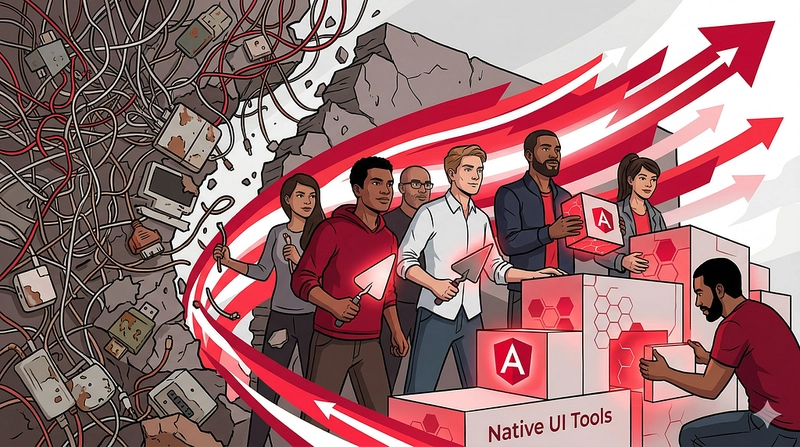
The Manifesto
So here’s the position, clearly:
- Stop calling wrappers “great Angular support.”
- Stop rewarding ecosystems that treat Angular as a checkbox.
- Stop acting grateful for tools that were never truly designed for Angular developers.
- Stop lowering the bar for what “Angular-native” should mean.
Start building:
- better Angular-first libraries,
- signal-based primitives,
- tooling that respects Angular architecture,
- products that feel like they belong in Angular, not merely tolerate it.
If Angular is good enough for the hardest problems, it’s good enough to deserve first-class tools.
If you are building for Angular, build with standards high enough that nobody has to ask whether it was native.
They should feel it instantly.
Angular Deserves Better
This is bigger than one editor, one library, or one complaint.
It’s about whether Angular developers keep accepting second-class tooling in a first-class framework.
You can read plenty of stories of teams who inherited Angular apps full of awkward wrapper libraries and half-baked integrations.
Once those abstractions land in a codebase, they stay there for years.
That’s why this matters.
The shortcuts you accept at the library level become the nightmares you debug at the product level.
The ecosystem quality tolerated today becomes the architecture debt inherited tomorrow.
Angular deserves better than wrappers.
And if the ecosystem is not going to hand Angular better native tools, then Angular developers will have to build them.
That’s not just a technical decision.
It’s a standards decision.
A community decision.
A respect decision.
So yes — stop treating Angular as a second-class framework for UI components.
And start building like it isn’t one.
I fix the Angular apps that generalists break.
I’m Karol Modelski, senior Angular developer and frontend architect rescuing legacy B2B SaaS frontends.
If your Angular app is slowing your team down, start with a 3‑minute teardown of your current setup: https://www.karol-modelski.scale-sail.io/


Top comments (0)