


Hundreds of developers have already completed our first DEV Education Track, and today we're excited to keep the momentum going with our second track in partnership with the team at Google AI.
This intermediate-level track will guide you through building distributed multi-agent systems using Google's Agent Development Kit (ADK), Agent2Agent Protocol (A2A), and Cloud Run. You'll learn to architect AI applications as coordinated teams of specialized agents rather than relying on a single monolithic prompt.
📖 Part 1: Follow the Expert Tutorial
Start with this comprehensive Codelab:

Building a Multi-Agent System | Google Codelabs
“Build a distributed multi-agent system from scratch using the Google Agent Development Kit (ADK) and A2A protocol.”
 codelabs.developers.google.com
You'll learn:
- Why specialized agents are more effective than monolithic prompts
- The architecture of distributed multi-agent systems
- How to master orchestration patterns
- How to implement the Agent-to-Agent (A2A) protocol for distributed communication
🤖 Part 2: Build Your Own Multi-Agent System
After you've worked through the tutorial, it's time to put your new skills to the test!
Your assignment is to build a multi-agent system that takes a task that would normally require "one giant prompt" and breaks it into specialized roles, accessible through a web interface.
Requirements:
- Multiple specialized agents: Each agent has a focused responsibility
- Deployed to Google Cloud Run: Agents must run as separate microservices
- Frontend application: Web interface deployed to Cloud Run that users interact with
We encourage you to come up with your own apps, but here are some ideas if you need inspiration:
- Email Drafter: Topic agent suggests what to write → Writer agent creates draft → Editor agent polishes tone
- Gift Idea Generator: Profile analyzer understands the recipient → Idea finder suggests options → Budget filter removes expensive items
- To-Do Prioritizer: Task analyzer reviews your list → Urgency checker ranks by deadline → Focus agent picks top 3 for today
✏️ Part 3: Earn Community Recognition
Everyone who completes the track by sharing their assignments will earn the exclusive "Multi-Agent Systems Builder" badge on their DEV profile!
Your submission should include:
- What you built: Describe the problem your system solves
- Cloud Run Embed: Embed your web app directly into the submission
- Your agents: Explain each agent's specialized role and how they work together
- Key learnings: What surprised you? What was challenging?
Use our official submission template to share your assignment:
Badge Design 😍
Our badge acts as a certificate of completion that you can highlight on your DEV profile. It'll look like this:
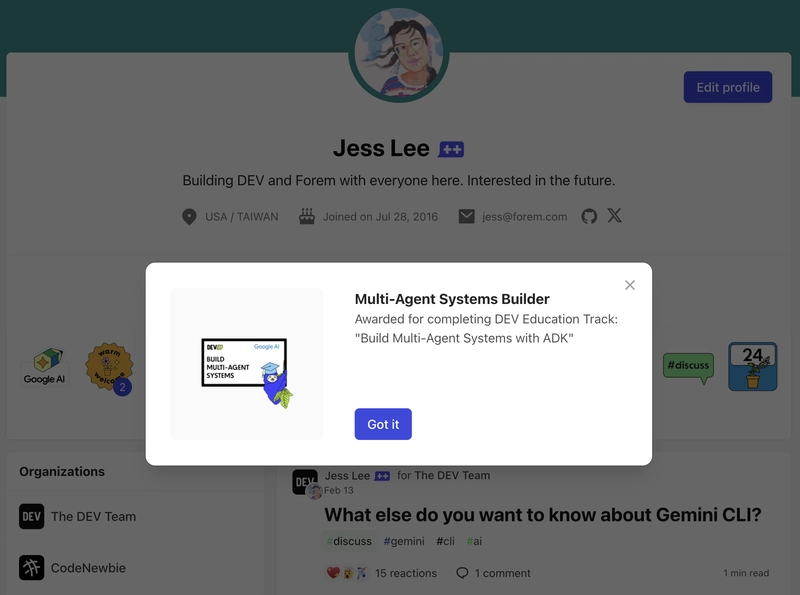
Our team will review submissions on a rolling basis with badges awarded every few days. There's no deadline, so take your time and build something you're proud of!
Why Multi-Agent Systems?
Multi-agent systems are one of the most important architectural patterns in production AI development. Just as you wouldn't ask a single developer to handle frontend, backend, database, and DevOps all at once, modern AI systems benefit from specialization. This track teaches you to create focused agents and coordinate them to solve complex problems that would otherwise overwhelm a single prompt.
We can't wait to see what you create. Happy building! ❤️


Top comments (24)
Good luck with this everyone!
The shift from monolithic prompts to specialized agents is the right architectural direction, but one thing I'd love to see covered in the track is how you handle trust boundaries between agents. When Agent A passes output to Agent B as input, you've essentially created a prompt injection surface at every handoff point. Curious if the A2A protocol has any built-in sanitization for inter-agent messages or if that's left to the developer.
I'm totally going to participate in this one 😁
Awesome!
Can't wait to see what everyone builds with this education track!
This is incredibly timely! I've been running a multi-agent system (OpenClaw-based) on a Mac Mini for autonomous content creation and distribution — sub-agents for coding, SEO, writing, and monitoring all coordinating via shared state files and cron jobs.
The biggest lesson: agent-to-agent communication design matters MORE than individual agent capability. Getting agents to validate each other's work was the hardest part. Excited to see Google's approach to this with ADK!
honestly the timing of this is perfect - I've been building multi-agent setups for a few months and the hardest part isn't the code it's figuring out how agents should hand off context to each other. ADK looked interesting when I first saw it but I wasn't sure it was production-ready. curious whether this track covers error handling in long-running chains - that's where I kept hitting walls
Multi-agent systems shine until you hit production inter-agent failures. ADK abstracts orchestration, but who debugs cascading timeouts between 5 Cloud Run instances at 3 AM? The real test isn't 'can it work'—it's 'can you trace why Agent C hallucinated because Agent A's output drifted'. Where's the observability story?
I wish I could get cloud shell but I don't like putting my mastercard in google services, else I could find out where to look
Sounds exciting, count me in.
This looks like a massive step forward for agentic workflows! As someone focused on smart contract security, I’m curious about the 'sandboxing' aspect of these multi-agent systems. When agents start interacting with external APIs or handling sensitive data/private keys, what built-in guardrails does ADK provide to prevent prompt injection or unintended logic execution? Great release, definitely worth exploring for automated security tooling.
My Agent Team started with 7, the Meta Agent decided it could absorb those 7 to work faster, and more efficiently, then decided to hire 3 back because during workflow postmortum it realized it was not as efficient doing detailed QA, HTML generation and Assessment creation. So we are back to 3+ the Meta Agent. I wrote an article about the whole process and creating SemVer agents who update themselves. Open sourced my Agent personas. The future of Agentic workflow is amazing!
Some comments may only be visible to logged-in visitors. Sign in to view all comments.