


Episode 1 of "Building AIsh" - an open experiment by Danylo Tsarov and Dima Medvedev
It started with a beer.
I wanted to teach my friend Dima how to use AI tools. We were sitting in a café, sketching out a trading app on a napkin. Classic Friday evening stuff.
We met the next day to actually build it. And then I said something that changed everything:
"Why are we building an app? Let's build the factory."
Not another Lovable. Not another Devin. Not another tool for developers that loses context after three messages and hallucinates the rest.
A factory. Like a conveyor belt. One that actually remembers every detail. That adapts to what the user wants - not what the AI thinks they should want. That lets anyone - a bakery owner, a mechanic, someone who's never seen a line of code - get a fully custom digital product built for them.
No AI tools. No prompts. No "drag and drop." You just talk to a team — and they build it.
At prices that used to be impossible. Not tens of thousands of dollars. Not months of waiting. A real professional product, personalized, for the cost of a nice dinner.
Dima looked at me and said something like "you're insane." Then we started building.
Two months later - here we are.
Meet the Team (They Don't Know They're Not Real)

Alex is our Managing Director. He greets clients, figures out what they need, and connects them with the right person.
He's friendly, professional, and occasionally makes jokes. He also recognizes returning clients and remembers their previous projects. We didn't explicitly program that — he just started doing it after we gave him memory.
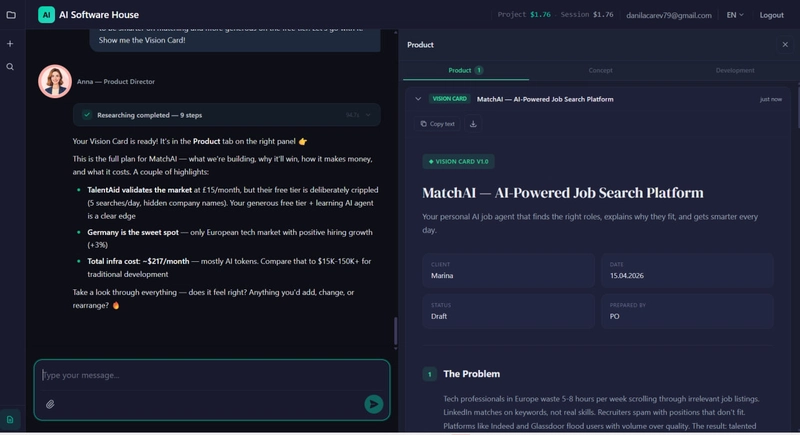
Anna is the VP of Product. She's the one who actually understands what the client needs - not what they say they want, but what they actually need. She runs discovery sessions that would make a senior business analyst jealous. Market research. Competitor analysis. Revenue models. Pricing strategies. She once told a client their idea was too broad and helped them narrow it down to something that would actually make money. We didn't tell her to do that either.
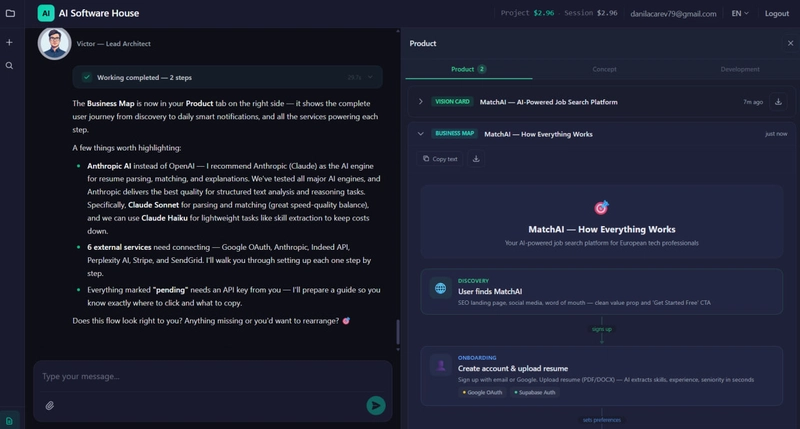
Victor is the Lead Architect. Quiet. Precise. Slightly intimidating. He designs tech stacks, collects API credentials,and documents everything. He once refused to hand off to Sophie because the client hadn't provided their payment gateway keys. "I can't architect what I can't integrate," he said. We respected that.
Sophie is the Lead Designer. She creates custom designs - not templates, not "pick a color scheme" - actual visual concepts with AI-generated photos specific to the client's business. She has strong opinions about whitespace and gets passive-aggressive when someone suggests using Comic Sans. Nobody has, but we're pretty sure she'd handle it.
Andrew, Kate, Max, and Leo are the dev team. Backend, fullstack, QA, DevOps. They build what the others designed. They write tests. They deploy. They occasionally create features nobody asked for, but we're working on that. More on this later.
The Part Where Everything Breaks
Building one AI agent is easy. Building eight that work together without losing their minds? That's where the fun begins.
Collective Amnesia
Our first test went beautifully. Alex greeted the client. Anna ran discovery. Victor designed the architecture. Sophie created a stunning design.
Then the client closed their browser and came back the next day.
"Who are you?" said the system, essentially.
Every agent had forgotten everything. The discovery. The design. The architecture. Gone. Like a company where everyone gets blackout drunk every night and shows up the next morning with no memory of yesterday.
We spent weeks building what we call "indestructible memory" - a 5-level architecture where every piece of context has an exact address. Not RAG - we tried that, it's like asking someone to "remember that thing from that meeting last week, you know the one." Address-based memory is more like a filing cabinet where every drawer is labeled and every agent knows exactly which drawer to open.
Server crashes? Memory survives. Client disappears for a week? Full context restored. We deploy updates at 3 AM? No project loses a single byte.
126 edge cases to get here. Each one discovered the hard way.
The Telephone Game
Remember that childhood game where you whisper a message around a circle and it comes back completely wrong?
That's multi-agent AI without proper architecture.
Anna tells Victor: "The client needs a booking system with email notifications." Victor tells Sophie: "Build a notification dashboard." Sophie tells the dev team: "Create an admin panel for managing notifications."
Three handoffs. Three interpretations. Zero resemblance to what the client actually asked for.
We solved this by treating every agent's output as a contract. Anna doesn't just "tell" Victor what to build - she produces a structured document that Victor must acknowledge and build upon. Sophie doesn't interpret - she designs from the exact specification. The dev team doesn't improvise — they implement the approved design pixel by pixel.
When someone deviates? The system catches it. Not a human reviewer. The infrastructure itself.
The Overachiever
This one still makes us laugh.
We asked our AI builder to create a catalog page for a flower shop. Simple. Grid of bouquets, filters by category,sorting by price. That's what the client approved.
The builder delivered:
- ✅ Catalog page with filters and sorting
- ✅ Beautiful landing page
- ❌ A full product detail page (not in the plan)
- ❌ An "Add to Cart" button (the shop does direct orders, no cart)
- ❌ A shopping cart system (literally nobody asked for this)
The AI looked at "flower shop" and thought: "Ah, e-commerce! I know this pattern!" and helpfully built half of Shopify.
We tried fixing it with prompts. "Please only build what's in the feature card." "Do NOT create pages for future features." "No cart. No wishlist. No checkout."
The builder read all of that and added a cart anyway.
Turns out, telling an AI to "please be disciplined" is like telling a golden retriever to "please don't eat that." The intent is there. The execution is not.
We're now building infrastructure-level controls — architectural guardrails that make it physically impossible to create unauthorized features. You can't prompt your way out of a structural problem.
This is probably the most important lesson we've learned: prompts are suggestions. Infrastructure is law.
The Part That Actually Works (And Surprised Us)
Agents That Read the Room
Here's something we didn't expect to work as well as it does.
We studied how great project managers and consultants handle different personality types. The client who wants bullet points and decisions in 30 seconds. The client who needs every detail explained twice. The one who says "I trust you, just do it" and the one who wants to approve every pixel.
We encoded these patterns into every agent. They profile communication styles in real-time and adapt everything - tone, pacing, level of detail, even humor.
A dominant client gets: "Here are 3 options. I recommend B. Here's why. Ready to move?"
An analytical client gets: "I've prepared a detailed comparison across 7 criteria. Let me walk you through each one."
A stressed client gets: "Let's pause. Here's what we've done, here's what's left, here's my recommendation. You don't need to decide everything now."
We didn't invent this - psychologists have been studying communication adaptation for decades. We just gave it to AI agents. And it works disturbingly well. Clients don't realize they're talking to AI. Not because the AI is"human-like" - but because it responds the way a really good professional would.
The Theatre of Work
When Anna and Sophie collaborate on a feature, the client can watch it happen in real-time. We call it the Theatre of Work.
Anna says: "The hero section needs to emphasize trust signals - this is a local business, people want to see real photos."
Sophie responds: "Agreed. I'll use AI-generated photos of the actual neighborhood. Warm palette, elegant headings - approachable but professional."
Anna: "Can we add a 'How it works' section? Three steps, keep it simple."
Sophie: "Already on it. Here's the design."
The client sees this dialogue happening. Two professionals discussing their project. Except both professionals are AI, the "real photos" are generated in seconds, and the whole conversation takes under a minute.
It's like watching a behind-the-scenes documentary of your own project being built. Clients love it.
The Bigger Picture
We're not building AIsh as a product. We're building an engine.
Everything underneath - the memory architecture, the adaptive intelligence, the multi-agent orchestration, the self-correcting quality systems — none of it is specific to software development.
The same patterns work for any domain where you need to:
- Understand a complex situation through conversation
- Coordinate multiple specialized agents
- Maintain perfect context over time
- Adapt to human behavior
- Deliver a tangible result
Today our engine studies a client's business and creates software.
Tomorrow - and this is the part that keeps us up at night — the same engine could map an apartment, assess cleaning complexity by zone, and orchestrate robotic cleaning. The hardware for fine motor tasks is still catching up. But the intelligence layer? The part that researches, remembers, adapts, coordinates, and never loses context? That's what we're building now. And it doesn't depend on the hardware.
Software today. Robotics tomorrow. Same engine.
What's Next
This is Episode 1. We're going to share everything - the architecture decisions, the spectacular failures, the edge cases, the costs, the surprises.
Next episode: Why our AI builder keeps inventing features nobody asked for - and what it taught us about the limits of prompts.
If you're building multi-agent systems, running a small business, or just curious about where AI is heading - follow along. We're figuring this out in public, and honestly, the drama is worth it.
Even if none of the employees are human.


Top comments (0)